What an Unlimited Deal Actually Covers
The word unlimited on an adult chat platform is a statement about access, not a promise that nothing is measured. What varies between offers is which dimension is unmeasured — messages, session length, memory — and the only way to know is to compare the label against your own usage. That comparison takes minutes: a heavy month of 90 messages a day is 2,700 messages, and knowing that figure turns a vague sales phrase into a testable claim.

Key takeaways
- Unlimited normally means unmetered access to the features the offer names, not the absence of usage data.
- The platform's own FAQ notes that limitations apply under its content and community guidelines, so latitude is bounded by policy rather than by a meter.
- Compare any offer against your own arithmetic: 8 a day is 240 messages a month, 30 a day is 900, 90 a day is 2,700.
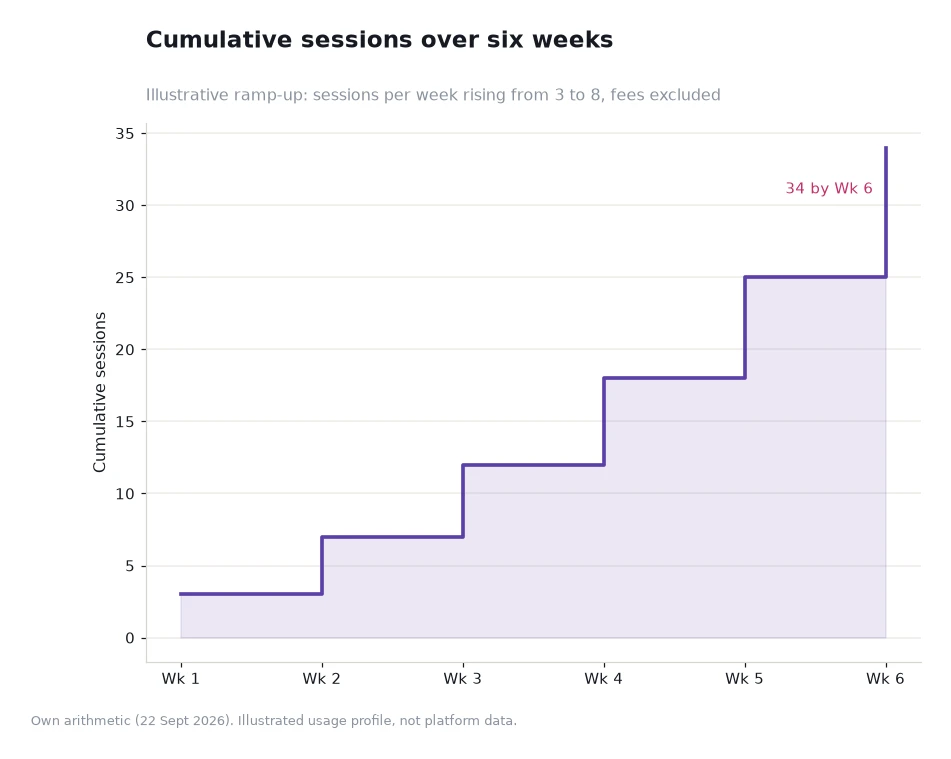
- Illustratively, six weeks at rising intensity accumulate 34 sessions from additions of 3, 4, 5, 6, 7 and 9.
What the label usually covers
In practice, unlimited describes access to the conversational features the page advertises: the characters, the memory behaviour and the ability to keep a thread going without watching a counter. That is a meaningful difference from a metered product, and it is also narrower than the phrase sounds, because it says nothing about how many conversations you can hold open or how long a single thread can grow.
The second thing the label does not cover is policy. The platform's FAQ states that some limitations apply in accordance with its content and community guidelines, which is a separate constraint from any commercial term. An offer cannot make content permissible that the guidelines exclude, so the two documents have to be read together.
The third is support and device scope. An offer applies to the account rather than to a phone, which is why signing in matters: sessions started on a desktop continue on a mobile device, and a deal that covers the account travels with it. Anyone wanting the platform's own framing can read the button wording on the Crushon unlimited plan page and compare it with the description on the product pages.
It is also worth separating an offer from a feature. An offer changes what is metered or how access is supplied; a feature changes what the product does. Bundling the two is the oldest trick in subscription design, and the way to spot it is to read the product pages first, where the feature list appears without reference to any commercial term.
Scope is the last practical check. If you use a phone during the week and a desktop at the weekend, confirm that an offer attaches to the account rather than to a device or a single session. The account is what carries threads and memory, so account-level terms follow you between screens while device-level terms do not.
Four questions that turn a label into terms
First: which dimension is unmetered? If the offer names messages but not session length, your heavy evenings are the thing to check. Second: does memory sit inside the offer? Continuity is the feature that makes a long thread worth returning to, so it is the one to confirm rather than assume.
Third: does the offer change anything about how the catalogue is filtered? A plan that changed which listings were visible would matter more than a message cap, and the filter row of Unfiltered, Filtered and 18+ is the place to verify what remains available. Fourth: what is the exit? An offer worth taking is one you can step out of without losing the threads you have built.
| Dimension | Question to ask | Why it decides the value |
|---|---|---|
| Messages | Is conversational volume unmetered? | Volume is the dimension most users exceed first |
| Session length | Is a long session treated differently from a short one? | Two sessions of 30 minutes and one of 60 are not equivalent |
| Memory | Does continuity sit inside the offer? | Continuity is the reason to return to a thread at all |
| Catalogue access | Do the usual filters still apply? | Visibility matters more than any usage cap |
| Exit | What happens to existing threads? | An offer that strands your history is not a bargain |
Worked example
Start with your own volume and the arithmetic is straightforward, using an illustrative profile rather than platform data. Light use at 8 messages a day is 8 × 30 = 240 a month. Regular use at 30 a day is 900. Heavy use at 90 a day is 2,700.
Now put the sessions behind those numbers. On the six-week ramp charted below, weekly additions of 3, 4, 5, 6, 7 and 9 produce cumulative totals of 3, 7, 12, 18, 25 and 34. Check the line: week one ends at 3; week two adds 4 for 7; week three adds 5 for 12; week four adds 6 for 18; week five adds 7 for 25; week six adds 9 for 34.
The useful comparison follows from the two sets together. A heavy month of 2,700 messages spread across, say, 34 sessions means roughly 79 messages per session — a figure that matters far more than the headline word, because it tells you which dimension you would actually be testing. If your own sessions run to 20 messages, the volume term is irrelevant and the memory term is everything.
Judging the offer from the product pages
The most reliable way to assess an unlimited offer is to read what the product claims separately from what the offer says. On this platform Crushon's Porn Chat AI description at the porn ai chat page lists three properties — customizable characters, full privacy and discretion backed by state-of-the-art encryption, and realistic advanced responses that recall earlier interactions and adapt over time. If an offer's terms sit comfortably alongside those three, it is describing the same product with a billing change attached rather than a different product.
Two habits make the assessment faster. Keep a fortnight of your own numbers before you read any offer, so the comparison is against evidence rather than a guess. And read the guidelines once, because the limitations the FAQ refers to apply the same way regardless of what you have chosen to pay — the AI chat blog documents features as they change and is the least abstract place to check whether anything relevant has moved.
Frequently asked questions
Does unlimited mean no restrictions at all?
No. It describes unmetered access to the features the offer names. The platform's guidelines still apply, and its FAQ states that some limitations follow from them.
Which dimension should I check first?
Session length. Volume is easy to estimate from your own history, while long sessions are the case where metering is most often hidden.
How do I know whether an offer suits me?
Compare it with a fortnight of real usage in messages and sessions. An offer that covers your heaviest month is the one worth reading twice.
Measure first, then read the offer
Log two weeks of messages and sessions, then read the offer with those figures in front of you. The terms that matter will be obvious within a minute.
If the offer covers the dimension you actually stress, the label has done its job. If it does not, no wording will close the gap. This piece is intended for adults aged 18 and over.
Data and sources: platform FAQ and guideline wording, product-page claims and button text on the unlimited plan page, read on 22 Sept 2026[1]. No pricing or subscription details are stated here because none were obtained. Message volumes, session counts and the 79-messages-per-session example are illustrative assumptions, not platform data. Adults 18+.