Pool Blocks, Orphan Rate and the 0.03% That Matters
A block is the unit of account behind every mining payout, and Bitcoin's network produces 144 of them a day at 450 BTC in subsidy. At 1 PH/s and difficulty 132.76 T, the block-reward share accrues at about 0.00001973 BTC an hour — roughly $1.68, or $1.62 after the listed 4% fee — and settles hourly under PPS+ rather than waiting on a block.

Key takeaways
- Blocks set the schedule: 144 a day network-wide, one roughly every 10 minutes, and 6 confirmations take about an hour.
- Hourly settlement decouples a miner's payout from block timing. At 1 PH/s the account accrues 0.00001973 BTC an hour and 0.00047353 BTC over a day.
- Orphan exposure depends on the payment method, not on the hardware: PPS+ settles the block-reward component per share, while PPLNS pays from blocks that actually confirm.
- Small percentages are cheap per machine and expensive per fleet: 0.03% of a day's block-reward share is about $0.012 at 1 PH/s and roughly $1.21 at 100 PH/s.
Blocks are the unit of account, not hours
Mining mathematics is written in blocks because issuance happens in blocks. The Bitcoin network pays 3.125 BTC per block across 144 blocks a day, and that 450 BTC is the pool every miner's share is drawn from. A pool's block count is therefore its activity record: it shows how often the pool was the one to find the next valid block, and how evenly that work was distributed against expectation.
Chains differ in how fast those units arrive. Litecoin pays 6.25 LTC across 576 blocks a day on 2.5-minute spacing, while Kaspa produces about 10 blocks every second. A pool dashboard for the three chains will show very different block counters side by side, and that difference says nothing about relative profitability. What it does affect is how quickly a pool's block record becomes statistically meaningful, and how often the orphan rate has a chance to move the total.
A block that never makes it into the chain is the awkward case. It was solved, it was submitted, and it paid nothing to anyone. Whether that loss lands on the pool or on the miner is decided entirely by the payment method — which is why orphan rate belongs on the same page as the fee schedule rather than in a footnote.
What a small percentage is worth
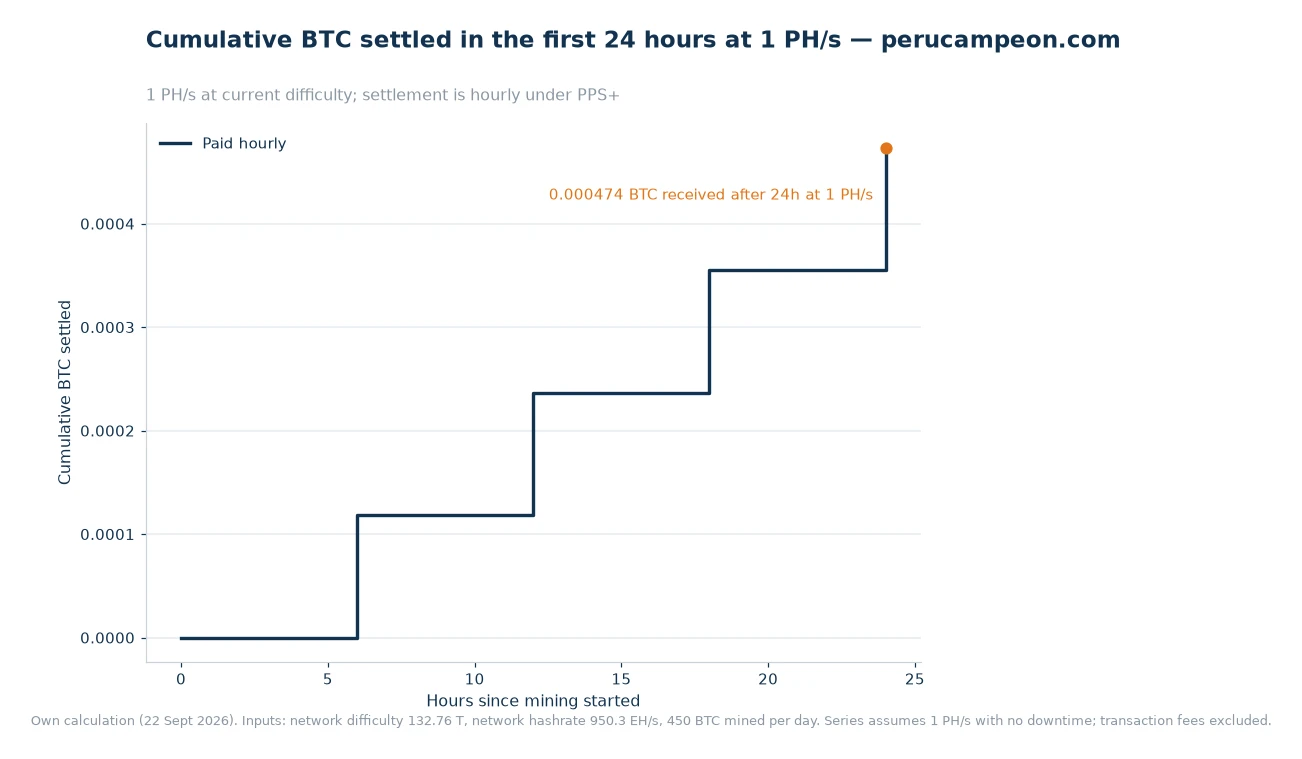
Percentages that decide payouts are usually small, so the useful exercise is converting them to money at a known hashrate. The table below does that for 1 PH/s in the first 24 hours of accrual, using gross and fee-adjusted figures at a BTC price of $85,294.
| Hours elapsed | Cumulative BTC at 1 PH/s | Gross value | After the listed 4% fee |
|---|---|---|---|
| 6 hours | 0.00011838 | $10.10 | $9.69 |
| 12 hours | 0.00023676 | $20.19 | $19.39 |
| 18 hours | 0.00035515 | $30.29 | $29.08 |
| 24 hours | 0.00047353 | $40.39 | $38.77 |
Now apply a fraction to the same base. Take the 0.03 percentage points that can separate two pools on the share of blocks that never reach the chain. At 1 PH/s, 0.03% of one day's block-reward share is about 0.00000014206 BTC, which is $0.012 — a rounding error on a single machine and $4.43 across a year.
Scale that up and the picture changes. The same 0.03 points at 100 PH/s is worth roughly $1.21 a day and about $443 a year. Nothing about the percentage moved. The base moved, which is the reason fleet operators read orphan behaviour while single-machine miners reasonably ignore it.
Worked example
Walk through 24 hours at 1 PH/s. Step one, the daily total: 1,000 TH/s multiplied by 0.0000004735 BTC per TH/s per day gives 0.00047353 BTC, which is $40.39 at $85,294. Step two, the hourly rate: divide by 24 to get 0.00001973 BTC, about $1.68.
Step three, the fee. The listed 4% applies to the block-reward component and takes about $0.06 off each hour, which leaves 0.00001894 BTC an hour, or $38.77 over the day. Step four, the settlement check: hourly payment at current difficulty means the account receives 24 entries for the day whatever the pool's block record looks like, because PPS+ pays per accepted share rather than per block found.
Step five shows why the distinction matters. Put the same 1 PH/s on PPLNS and the payout depends on blocks the pool finds inside the last 5 difficulty rounds, paid after 6 confirmations. On Bitcoin, five rounds at 2,016 blocks each span about 70 days at current cadence, so a block that never confirms is a block that never enters the window — the loss is shared across everyone in it, and the compensation for carrying that is the listed 2% rate on both reward components together instead of 4% plus 2%.
Who carries a block that never confirms
Under PPS+ the miner does not carry it on the block-reward side. The block-reward component is settled at PPS against accepted shares and paid hourly at current difficulty, so a block that fails to confirm changes the pool's economics rather than the miner's hourly credit. That is what the listed 4% on this component pays for, and it is why the rate is higher than the PPLNS alternative.
Under PPLNS the miner carries it, and the fee is correspondingly lower at a listed 2% on both components combined. The window matters here: because the payout is measured over the last 5 difficulty rounds after 6 confirmations, a miner's exposure is not confined to the blocks found while their machines were running. It is a pooled, lagged exposure, which is precisely the trade being made.
Two habits keep orphan behaviour from becoming a surprise. The first is checking block counts and Pool Luck against the pool's published figures rather than inferring them from payout timing; the numbers live in the same pool statistics view as network hashrate and difficulty, so there is no reason to guess. The second is modelling the worst case before choosing a method, which is a two-minute exercise with the Profit Calculator at the hashrate actually being deployed.
Keep the fee wording straight while doing it, too. A ViaBTC Pool Hashrate view tells you what the pool is doing; the schedule tells you what you pay for the protection or the variance you have chosen, and the two are separate decisions that are often confused into one.
Frequently asked questions
Does an orphaned block reduce my payout under PPS+?
Not on the block-reward component. PPS+ settles that component per accepted share and pays hourly at current difficulty, so a block that fails to confirm affects the pool's exposure rather than your hourly credit. Transaction fees are handled separately.
How many blocks does the Bitcoin network find in a day?
144 blocks, carrying 3.125 BTC each, which is 450 BTC of subsidy a day across the whole network. Spacing works out to roughly one block every 10 minutes, and six confirmations therefore take about an hour.
At what hashrate does orphan rate start to matter?
It matters in proportion to the base. At 1 PH/s a 0.03-point difference is about $0.012 a day, while at 100 PH/s the same difference is near $1.21 a day and roughly $443 a year.
Read blocks, luck and fees on one page
Block counts, Pool Luck and the fee schedule are three views of the same exposure, and they should be reviewed together rather than one at a time. Confirm the cadence of the chain being mined, check the pool's block record against expectation, and price the difference between the listed rates before signing up for a method. For a small fleet on PPS+ that review takes minutes a month. For a large one, the same minutes protect a number worth four figures a year, which is exactly the kind of arithmetic that rewards being written down early.
Rates and fees: the ViaBTC listed schedule for PPS+ and PPLNS[1]. Inputs used were BTC difficulty 132.76 T, a block subsidy of 3.125 BTC across 144 blocks a day, network hashrate near 950.3 EH/s and a BTC price of $85,294, plus LTC and KAS block cadences, read from public chain data and market feeds on 22 Sept 2026. All values are arithmetic on the stated inputs; they are not forecasts and not promises of earnings. read 22 Sept 2026.